
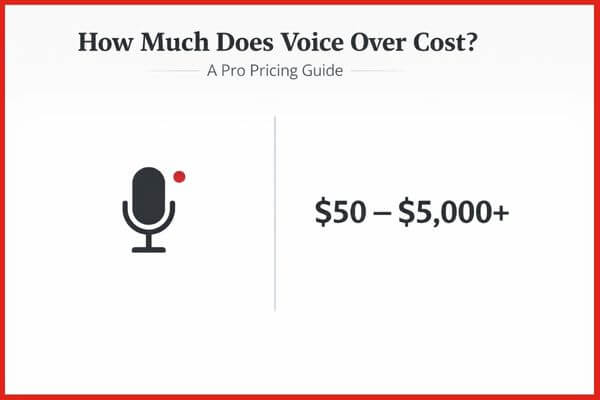
How Much Does Voice Over Cost? Pricing Guide From a Pro
How Much Does Voice Over Cost? (A Clear, Real-World Guide from a 30-Year VO Professional)
If you’ve ever tried to hire a voice over artist, you already know the pricing can feel…mysterious.
One website says $50. Another says $5,000.
AI voices promise “unlimited usage for pennies.”
And traditional rate guides span multiple pages with formulas that feel more like tax codes than creative work.

So let’s simplify it.
I’ve been recording voice over for more than 30 years — for Acura of North America, Biltmore House & Gardens, the USS Bowfin Submarine Museum at Pearl Harbor, the Missouri Department of Conservation, countless small businesses, political campaigns, ministries, and even the occasional video game.
In this guide, I’ll break down exactly what voice over costs, why prices vary, and how to understand the ranges without getting lost in jargon.
You'll learn:
What determines voice over cost
Typical price ranges for narration, eLearning, faith-based content, political spots, and blog-to-audio
How usage rights affect pricing (in plain English)
Case studies from real projects
Why “cheap” voice overs often end up expensive
Why human voices still outperform AI in almost every meaningful way
Let’s answer the question once and for all.
What Determines Voice Over Pricing?
Voice over pricing usually comes down to five main factors:
1. Script Length
Shorter scripts take less time to record and edit. Longer scripts (especially eLearning) require performance consistency, pacing, and stamina.
2. Usage Rights

This is simply where and how your audio will be used.
More reach = more value.
3. Produced vs. Raw Audio
Raw audio is clean and ready for your engineer. Produced audio includes all post-production: EQ, compression, noise removal, leveling, music integration, etc.
4. Turnaround Time
Fast delivery (24–48 hours) is standard for short projects.
Major narrations require coordinated deadlines.
5. Number of Deliverables
One finished file = one price.
Twenty separate files = more time, attention, and cost.
These factors apply to nearly every VO category.
Now let’s get practical.
Voice Over Price Ranges (Straightforward & Aligned with GVAA Standards)

Below are general ranges based on GVAA guidelines, industry standards, and my own 30-year career.
These aren’t exact quotes — they’re meant to help you understand what’s normal and why.
1. Corporate Narration
Typical Range: $250 – $750+ for 1–5 minutes
Longer Narrations: $750 – $3,000+ depending on length, usage, and complexity
Corporate narration includes:
Company overview videos
Training modules
Product explanations
Internal messaging
Brand story videos
Case Study: Corporate Culture Video
A regional company needed a 3-minute internal video for new employees.
Usage: internal only
Deliverable: one produced file
Turnaround: 48 hours
Rate: $450
That video is still in use four years later — a one-time cost that continues to deliver value.
2. eLearning Voice Over
Typical Range: $0.20 – $0.50 per word
or
$500 – $2,500+ per finished hour
eLearning requires clarity, pacing, consistency, and vocal durability. It’s not just reading text — it’s educating.
Why eLearning Costs More
Longer scripts
Multiple modules
Strict pacing standards
Separate file exports
Retakes when content updates
Mini Case Study: 10-Module eLearning Program
A coaching organization hired me to record 10 modules totaling ~8,000 words.
Usage: online course
Deliverables: 10 produced files
Rate: $1,200
Outcome: the program continues to generate revenue for them month after month.
3. Faith-Based Content
Typical Range: $200 – $500 for short-form narration
*$500 – $1,500+ for sermon intros, devotional content, or long-form narration
Faith-based content is typically more emotional, more intentional, and more personal.
As someone who started in acting — not radio — I learned early how to deliver emotionally true readings of written material. This matters even more in faith-driven projects.
Case Study: Devotional Narration
A ministry needed a 12-minute devotional reading for their YouTube channel.
Usage: online
Deliverable: one produced file
Rate: $350
Impact: The video became their most shared content that month.
4. Political Commercials
Typical Range:
Local/County: $250 – $750
Statewide: $750 – $2,500
Digital Only Ads: $250 – $750
Broadcast TV/Radio: varies by market size + usage term
Politics is unique because it blends:
urgency
messaging nuance
usage complexity
high-stakes emotional read
I’ve produced a lot of political spots, written a few, and voiced a select number of them — enough to know how dramatically usage affects cost.
Key Point:
A county-level ad is not the same as a statewide broadcast buy.
One reaches tens of thousands.
The other reaches millions.
The cost reflects that difference.
5. Blog-to-Audio (Turning Written Content into a Podcast Version of Your Blog)
Typical Range: $150 – $400 for short posts
*$300 – $1,000+ for long articles or recurring monthly content
This service is growing fast because:
It gives your blog a second life
It improves SEO
It increases time-on-page
Readers become listeners
Content becomes multi-platform friendly
This is perfect for coaches, pastors, consultants, and creators who want an “audio version” of their thought leadership.
Understanding Usage Rights (Simple Explanation)
Usage rights determine the value of the audio.
Think of it like renting vs. buying a billboard:
Internal corporate video: Seen by employees → lower usage
YouTube ad: Reaches thousands → medium usage
Statewide broadcast commercial: Reaches millions → high usage
More reach = more impact = more value.
That's all usage rights are.
Why "Cheap" Voice Over Often Becomes Expensive
Here are the biggest red flags:
1. They have only one style of delivery.
When you need warmth, authority, humor, empathy, or a conversational tone…
…they can only do one thing.
2. Missed deadlines and excuses.
If a talent can’t deliver a simple file on time, the rest of your project is at risk.

3. Poor audio quality.
Low-end equipment, room noise, or inconsistent levels mean you pay an engineer to fix it — or worse, rehire someone else.
4. Limited experience means limited nuance.
Anyone can read words.
It takes a trained actor to move an audience.
Why Human Voice Over Beats AI (Every Time)
I’ll be direct:
AI can’t replace emotional truth.
Not in faith-based content.
Not in corporate messages.
Not in political spots.
Not in storytelling.
Not in teaching.
AI produces sound.
Humans produce meaning.
And that meaning is what your audience connects to.
Real-World Summary of Voice Over Pricing

These are ranges — not quotes — but they reflect real-world industry pricing.
My Voice Over Philosophy
“A 60-second recording took me 30 years to learn how to perform.”
When you hire a professional voice talent, you’re not paying for one minute of audio.
You’re paying for decades of training, emotional understanding, performance skill, reliability, and the ability to elevate your message — not just record it.
From Acura to Biltmore House & Gardens, from ministries to political campaigns, from eLearning modules to family-owned businesses — the goal is always the same:
Deliver a message worth listening to.
Ready to Bring Your Script to Life?
If you’d like a personalized quote for your project — large or small — I’m happy to help.
Let’s make something powerful together.
